Tips for Effective Denture Adhesive Use

Photo: freepik.com/Freepik
Using denture adhesive is an essential part of the daily routine for people who wear removable dentures. Although applying denture adhesive may seem simple, it is important to follow the right technique to ensure denture stability, comfort and oral health.
Here, Dana Zālīte, director of the Health and Beauty Centre Adoria, explains how to use denture adhesive correctly to ensure comfort and stability throughout the day.
Preparing the Denture and Oral Cavity for Adhesive Application
Before applying denture adhesive, it is important to ensure that both the denture and the oral cavity are completely clean and dry. Thorough oral hygiene is an essential step toward effective denture adhesive use.
- For cleaning the denture, it is recommended to use a special denture‑cleaning agent and a soft dental brush, performing careful mechanical cleaning to remove all food residues and plaque from the denture surface. After that, the denture should be carefully rinsed with lukewarm water and dried with a soft, clean cloth, paying particular attention to the inner surface and all grooves.
- Next, attention should be paid to the preparation of the oral cavity. The mouth should be rinsed with lukewarm water or an antiseptic mouth rinse to remove bacteria and food particles, thereby reducing the risk of infection. Then the gums should be gently dried with a soft cloth, avoiding strong friction that could irritate the mucosa. If the gums are inflamed or sensitive, a special gum balm or gel may be used to reduce discomfort and promote tissue regeneration.
A dry and clean surface ensures optimal adhesion of the denture adhesive, prolongs its duration of action and minimises movement of the denture. Proper preparation of the denture and oral cavity before adhesive application is important not only for comfortable denture use, but also for maintaining oral health, minimising the risk of mucosal trauma and inflammation.

Photo: freepik.com/Freepik
Choosing and Applying Denture Adhesive
The range of denture adhesives is broad, and the choice depends on individual needs and preferences. If the gums are sensitive, it is preferable to choose a hypoallergenic adhesive without zinc or strong flavourings, while for patients who have difficulty keeping the denture in place, for example due to significant gum recession, an adhesive with stronger fixation is recommended.
Some patients may be allergic to certain adhesive components; therefore, attention should be paid to any allergic reactions, such as redness, itching or burning. For the best‑suited choice of denture adhesive, it is advisable to consult your dentist, who will recommend a product appropriate for the denture material and your individual needs.
After the denture and oral cavity have been prepared, denture adhesive can be applied as follows:
- the denture is first cleaned and thoroughly dried to ensure optimal adhesion;
- the adhesive is applied in a thin, even layer on the inner surface of the denture that will contact the gums;
- the adhesive should not be applied too close to the edges of the denture, as this can cause it to squeeze out and cause discomfort;
- if there are dental crowns or a bridge in place, denture adhesive should be applied carefully to avoid getting on these structures and making denture removal difficult.
Inserting and Fitting the Denture
After applying the adhesive, the denture should be carefully inserted into the mouth. It is important to ensure that the denture fits snugly against the gums, without pressure points or discomfort. After insertion, the denture should be pressed evenly against the gums, distributing the pressure uniformly and held in place for approximately 30–60 seconds until the adhesive activates and provides initial fixation.
During this time, it is recommended to perform small chewing‑like movements to optimise the denture’s position and the distribution of the adhesive. After that, to ensure complete fixation and maximum stability, it is advisable to avoid eating and drinking for at least 30 minutes.
Removing Denture Adhesive and Oral Care
For removing remaining denture adhesive, it is recommended to use special products designed for this purpose, available at pharmacies. These products effectively remove adhesive from the denture without traumatizing its surface. If such products are unavailable, lukewarm water can be used.
- After removing the denture, it should be thoroughly washed with a denture‑cleaning agent and running water to completely remove adhesive residues and food particles.
- Particular attention should be paid to the inner surface and the attachment elements, where bacteria accumulate most intensively.
- The gums and oral cavity should be cleaned of any remaining adhesive using a soft toothbrush or fingers, performing gentle circular motions. After that, it is recommended to use a moisturising mouth rinse or balm, which can help reduce gum irritation, hydrate the mucosa and maintain good oral hygiene.
Frequently Asked Questions About Denture Adhesive Use
- How often should denture adhesive be changed?
The frequency of changing denture adhesive depends on individual needs and the manufacturer’s instructions. Usually, denture adhesive should be changed once a day. However, if the denture begins to move or causes discomfort earlier, the adhesive should be changed more frequently.
- Can denture adhesive damage dental crowns or a bridge?
When used correctly, denture adhesive does not damage dental crowns or a bridge. However, if the adhesive is applied to the part of the denture that contacts the crowns or bridge, it can make denture removal more difficult and may cause damage.
- How to maintain good oral hygiene when using dentures?
Careful oral hygiene is especially important when using dentures. In addition to cleaning the denture, it is important to clean the gums, tongue and palate regularly with a soft toothbrush or a special tongue cleaner. It is also recommended to use an antiseptic mouth rinse to reduce bacterial growth and lower the risk of inflammation.
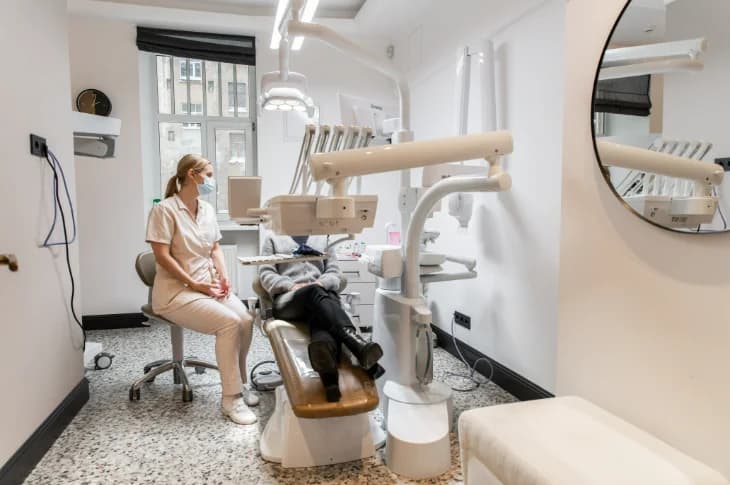
Photo: adoria.lv
Entrust the Care of Your Dental Beauty to the Specialists at Adoria Dentistry!
Dental prosthetics, implantology, oral surgery and other dental services for the whole family at the Health and Beauty Centre Adoria, A. Čaka iela 70‑3!