Dental Crowns or a Bridge: How to Choose the Best Solution?
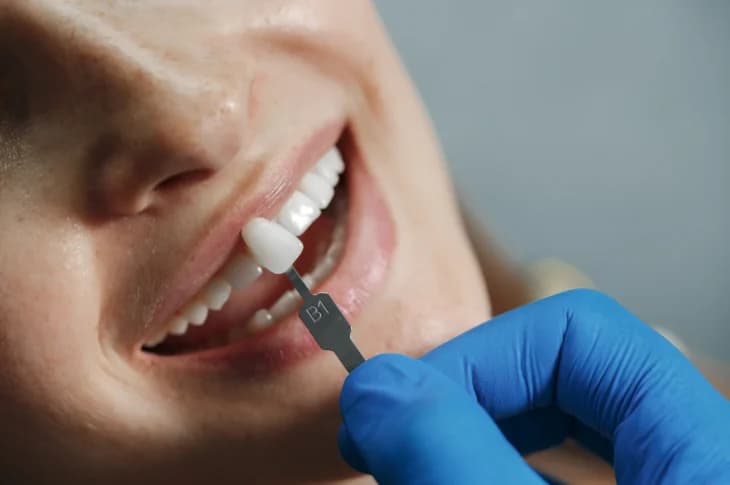
Photo: freepik.com/Freepik
In dental prosthetics, dental crowns and bridges are widely used solutions for restoring damaged, weakened or missing teeth. Although both methods may look similar, their indications, technical nuances and benefits differ.
Here, dentist Ieva Breča from the Health and Beauty Centre Adoria explains how to choose the restoration solution that best suits your needs and what the key differences are between dental crowns and dental bridges.
Dental Crowns: Indications, Placement and Materials
Dental crowns are fixed prostheses used to restore the function and aesthetics of a damaged or weakened tooth. They completely cover the tooth, providing protection and strength. Crowns are fabricated individually for each patient in a dental laboratory using dental impressions or digital scans. Their purpose is to restore the tooth’s natural shape, size, bite and appearance.
Indications for Dental Crown Placement
- Extensive tooth damage: when carious or traumatic damage has affected a significant portion of the tooth crown, exceeding 50% of its structure, a filling is no longer sufficient to ensure the tooth’s integrity and function. In these cases, dental crowns serve as an artificial tooth crown, restoring its shape, strength and aesthetics.
- Changes in tooth structure: wear, cracks or fractures of enamel and dentin caused by bruxism, erosion or trauma can significantly weaken a tooth. Crowns help protect such teeth from further destruction and fracture, while restoring their natural shape and function. Teeth that have undergone endodontic (root canal) treatment often become more fragile, and dental crowns can provide the necessary protection.
- Correction of aesthetic defects: dental crowns are an effective solution for correcting various aesthetic defects, such as discoloration. They can also correct tooth shape or alignment, for example irregular contours or rotation.
- Implantology: dental implants are artificial tooth roots made of titanium, resembling screws. They are placed in the jawbone and serve as a foundation for further dental reconstruction. Dental crowns function as the visible part of the implant, restoring the aesthetics and functionality of the missing tooth.
- For bridges: when choosing a bridge for dental prosthetics, the bridge structure is often supported by adjacent teeth, which are covered with crowns to ensure the bridge’s stability and durability. Dental crowns act as abutments for the bridge, transferring chewing forces to the supporting teeth. Bridge designs can vary, and the crowns are adapted to the specific clinical case.
Dental prosthetics and smile restoration are complex processes that often combine dental surgery and other dental procedures. To learn when it is necessary to seek the help of an oral surgeon, read the article “Oral Problems When You Should See an Oral Surgeon.”
The Process of Dental Crown Placement
- Tooth preparation: before crown placement, the dentist evaluates the tooth’s condition, performs caries and other defect diagnostics, and checks the health of the surrounding gums. A radiographic examination is taken to obtain a precise view of the tooth anatomy and possible pathologies, allowing assessment of the root canal status, bone structure and other anatomical features. The tooth is then prepared by grinding, to create space for the crown. The depth of grinding depends on the chosen crown material and design. If the tooth damage is extensive or pulpitis is detected, root canal treatment is performed first.
- Taking the impression: after tooth preparation, a precise impression is taken using flexible impression materials that accurately replicate the prepared tooth and surrounding tissues. The impression includes both the prepared tooth and the opposing jaw, as well as a bite registration, which is necessary to fabricate a crown that fits the patient’s individual anatomy. In modern dentistry, digital impression‑taking with an intraoral scanner is increasingly used, allowing a three‑dimensional model to be obtained. This method is more precise, faster and more comfortable for the patient than conventional impression‑taking.
- Placement of a temporary crown: to protect the prepared tooth from external influences, thermal irritation and bacterial invasion, and to maintain aesthetics until the permanent crown is placed, a temporary crown is installed.
- Placement of the permanent crown: when the permanent crown has been fabricated, it is fitted at the next appointment, and its fit, shape, color and bite are evaluated. If necessary, the crown is sent back to the laboratory for corrections to ensure optimal function and aesthetics. Once the crown is perfect, it is cemented to the prepared tooth with a special dental cement that provides a strong, hermetic seal. The dentist then checks the bite and makes any necessary adjustments.
Dental Crown Materials
- Plastic dental crowns: these crowns are mainly used as a temporary solution while the permanent crown is being made. Their advantage is low cost and rapid fabrication. However, plastic crowns are not durable against wear or staining and are not suitable for long‑term use.
- Metal‑ceramic crowns: these crowns have a metal base covered with a layer of ceramic. The metal framework provides strength and longevity, whereas the ceramic covering gives a natural tooth appearance. Metal‑ceramic crowns are relatively affordable and durable, but their aesthetics can be limited because the metal base may show through the ceramic near the gum line.
- All‑ceramic/zirconia dental crowns: made from high‑strength ceramic. They are biocompatible, resistant to wear and staining, and offer excellent aesthetics, allowing them to closely mimic natural teeth. Zirconia crowns are particularly strong and can be used to restore both front and posterior teeth. All‑ceramic crowns are more expensive than metal‑ceramic crowns, but they offer the best aesthetics and biocompatibility.
The choice of material depends on the patient’s individual needs, preferences and financial possibilities. The specialist helps select the most suitable crown material, taking into account the tooth’s condition, position and functional requirements.
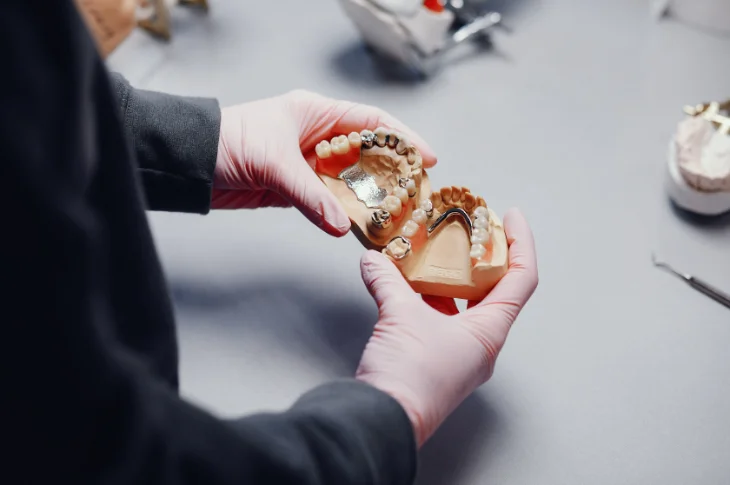
Photo: freepik.com/Freepik
Dental Bridges: When Are They Needed?
Dental bridges are an effective way to restore not only the aesthetics of the smile, but also the natural functions of the teeth. They are recommended when one or several teeth are missing and the adjacent teeth are healthy enough to serve as abutments for the bridge. In such cases, dental prosthetics with a bridge help restore chewing function, prevent tooth movement and improve speech clarity.
Indications for Dental Bridges
- One or more missing teeth: dental bridges are suitable for replacing one or several missing teeth, closing gaps in the dental arch, restoring an aesthetic smile and natural dental function.
- Suitable abutment teeth: there must be teeth with adequate bone support and good periodontal health to serve as abutments for the bridge.
- Insufficient bone volume for implants: when bone atrophy has occurred after tooth loss, and there is not enough bone volume for implant placement, a dental bridge can serve as an alternative.
- Patient preference to avoid surgery: bridge placement is a less invasive procedure compared with implant placement, which can be a decisive factor for some patients.
- Limited budget: dental bridges are a more financially accessible alternative to implants.
Dental Bridge Placement
The process of bridge placement is similar to crown placement. However, it is important to remember that bridge placement is an irreversible procedure, because the abutment teeth must be ground down to accommodate the bridge structure. Before deciding on a dental bridge, it is important to consult a dentist to evaluate all possible treatment options and choose the most suitable one.
- Preparation of abutment teeth: the dentist grinds the abutment teeth, removing part of the enamel and dentin to create space for the crowns.
- Taking the impression: a precise impression is taken from the prepared teeth and surrounding tissues, which is used to fabricate the bridge in the dental laboratory.
- Temporary bridge placement: while the permanent bridge is being fabricated, a temporary bridge is placed to protect the prepared teeth and maintain aesthetics.
- Placement of the permanent bridge: once the bridge is ready, the dentist fits it and makes any necessary adjustments. The bridge is then cemented to the abutment teeth with a special dental cement.
- Bite check and adjustment: after bridge placement, the dentist checks the bite and performs the necessary adjustments to ensure proper contact surfaces.

Photo: adoria.lv
Regain Your Beautiful Smile at the Health and Beauty Centre Adoria!
Dental prosthetics, dental implantology, oral surgery and other dental services, using modern, state‑of‑the‑art equipment and materials at the Health and Beauty Centre Adoria, A. Čaka iela 70‑3!